Gayatri Mantra: Meaning, Benefits, Chanting Rules & 108 Japa Guide
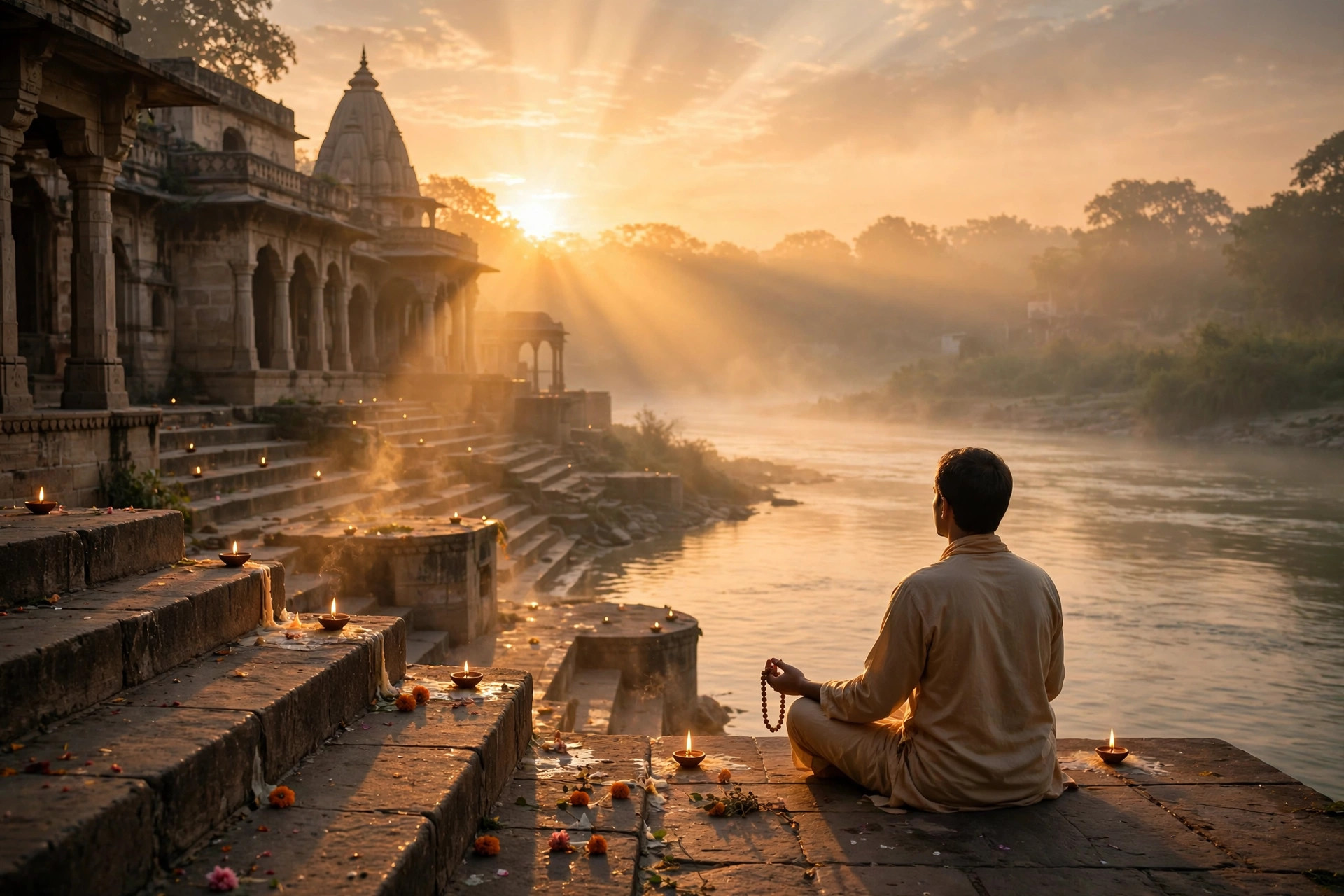
Quick Answer (Summary) The Gayatri Mantra is the most revered mantra of the Vedas — a prayer to Savita, the divine light behind the Sun, asking that light to illuminate our intellect. It comes from the Rigveda (Mandala 3, Sukta 62, Verse 10), revealed to Rishi Vishvamitra, and is chanted in the Gayatri metre of 24 syllables. Traditionally it is recited at the three Sandhyas — sunrise, midday and sunset — in counts of 3, 11, 27, 54 or a full mala of 108. Anyone can begin with a few sincere repetitions at sunrise; consistency matters far more than quantity.
The Mantra: Text, Transliteration and Translation
Devanagari
ॐ भूर्भुवः स्वः तत्सवितुर्वरेण्यं भर्गो देवस्य धीमहि धियो यो नः प्रचोदयात्
Transliteration
Om Bhur Bhuvah Svah Tat Savitur Varenyam Bhargo Devasya Dhimahi Dhiyo Yo Nah Prachodayat
Plain translation
We meditate on the adorable radiance of Savita, the divine Creator. May that light inspire and guide our intellect.
Notice what this mantra does not ask for. It does not ask for wealth, victory or a specific result. It asks for one thing only — a clear, illumined intellect (dhiyo). That is why generations of teachers have called it the safest and most universal prayer in the Vedic tradition: if the intellect is lit, every other decision in life gets easier.
The mantra is preceded by Om and the three Vyahritis — Bhur, Bhuvah, Svah. Together they are called the Mahavyahriti, the great utterance that frames the prayer.
Where the Gayatri Comes From
The verse appears in the Rigveda, Mandala 3.62.10, and is also found in the Yajurveda and Samaveda traditions. It is attributed to Brahmarishi Vishvamitra, the sage of the third Mandala of the Rigveda, who is honoured as the mantra's drishta — the seer who realised it in deep meditation, rather than an author who invented it.
It is called Gayatri because it is set in the Gayatri metre: three lines (padas) of eight syllables each, 24 syllables in total. It is also called the Savitri Mantra, because it is addressed to Savita — the solar aspect of the divine that gives life, light and movement to the world. In later tradition Gayatri is personified as Vedamata, the Mother of the Vedas, and in the Bhagavad Gita, Krishna identifies himself with Gayatri among sacred metres.
Historically, the mantra was the heart of the Upanayana ceremony: the guru whispered it into the student's ear at initiation with the sacred thread (yajnopavita), and the student then recited it daily in Sandhyavandana for life. Modern reform movements opened the practice widely, and today it is chanted by men and women of all backgrounds, in temples, homes, classrooms and meditation halls.
Word-by-Word Meaning
Understanding each word transforms mechanical repetition into prayer. Here is the breakdown most traditional commentaries agree on:
| Word | Meaning |
|---|---|
| Om | The primordial sound, the source vibration |
| Bhur | The physical world, earth, existence |
| Bhuvah | The intermediate world, vital energy, space |
| Svah | The celestial world, light, bliss |
| Tat | That (the Supreme Reality) |
| Savitur | Of Savita, the divine Sun / Creator, source of all |
| Varenyam | Most adorable, worthy of worship and choice |
| Bhargo | Radiance, effulgence that burns away ignorance |
| Devasya | Of the divine, of God |
| Dhimahi | We meditate upon |
| Dhiyo | Intellect, understanding (plural — for all beings) |
| Yo | Who |
| Nah | Our |
| Prachodayat | May inspire, impel and guide |
Two details are worth pausing on. First, dhiyo and nah are plural — we pray for our intellects, not mine alone. The Gayatri is a collective prayer, for the illumination of everyone. Second, bhargo does not mean ordinary light; it is the radiance that destroys darkness and impurity, like sunlight dispelling fog.
Benefits Traditionally Associated with Gayatri Japa
Scriptures and teachers describe the fruits of regular japa in layered terms. Treat these as the tradition's claims and the lived experience reported by practitioners, not as medical guarantees:
- Clarity and concentration — the mantra is a prayer for buddhi, so students traditionally chant it before study to steady attention and aid memory.
- Calmness — slow, rhythmic repetition with breath naturally settles restlessness; many practitioners report reduced mental chatter after even 11 repetitions.
- Discipline — a fixed daily practice at a fixed hour builds a sattvic routine around which the rest of the day organises itself.
- Protection and positivity — in traditional language, Gayatri is a kavacha, an armour of light around the practitioner; in practical language, beginning the day with a noble intention changes how the day is met.
- Spiritual growth — because the mantra points beyond worldly requests toward illumination itself, long-term japa is considered a complete sadhana in its own right.
A sober note: mantra practice complements study, work, rest and medical care — it does not replace them. The tradition itself is clear that japa works best alongside right effort.
When to Chant: The Three Sandhyas
The Gayatri belongs to Sandhyavandana, the worship performed at the junctions (sandhya) of the day:
| Sandhya | Time | Direction faced | Character |
|---|---|---|---|
| Pratah Sandhya (morning) | Brahma Muhurta to sunrise, ideally completing just before/around sunrise | East | Sattvic, fresh — regarded as the most powerful sitting |
| Madhyahna Sandhya (midday) | Around local noon, sun overhead | East or north | Shortest sitting, for steadiness in action |
| Sayam Sandhya (evening) | Just before and around sunset | West | Reflective, for releasing the day's fatigue |
If three sittings are impossible, teachers across lineages make the same practical concession: do the morning sitting without fail, add the evening sitting when you can, and never let an imperfect schedule become a reason to abandon the practice entirely.
You can check sunrise, sunset and Brahma Muhurta for your city every day on the Daily Panchang.
How Many Times? Counts and What They Mean
| Count | Common name / use |
|---|---|
| 3 | Minimum at each Sandhya when time is very short |
| 11 | A gentle daily beginner's practice |
| 27 | Quarter-mala, a focused short sitting |
| 54 | Half-mala |
| 108 | One full mala, the classic daily japa |
| 1008 | Special sadhana / purascharana observances, under guidance |
Beginners are advised by almost every tradition to start small — 11 repetitions done daily with attention will do more than 108 done once with distraction. Increase the count only when the smaller count has become stable and unhurried. A full mala of 108 typically takes 10 to 20 minutes at a calm pace.
Why 108? The number is woven through Vedic practice: 108 beads in a mala, 108 names in an ashtottara, and in Vedic astronomy a striking relationship between the Sun, Moon, Earth and their distances measured in their own diameters. Whatever explanation you prefer, the mala's job is simple — it counts so your mind does not have to.
Step-by-Step: How to Do Gayatri Japa
- Bathe or freshen up. At minimum, wash face, hands and feet. Sit in a clean, quiet place, ideally before a lamp or image, or simply facing the rising sun.
- Sit steady. Use an asana (mat or cloth) rather than the bare floor. Keep the spine straight, shoulders relaxed. Use a tulsi or rudraksha mala if you have one.
- Set the intention (sankalpa). Hold a little water in the right palm if you follow Sandhyavandana, or simply take three slow breaths and state your purpose silently: clarity, steadiness, gratitude.
- Begin with Om. Chant a few slow Oms, then the Vyahritis, then the mantra itself.
- Chant at an even pace. The three traditional modes are vachika (aloud, best for beginners), upanshu (whispered, lips moving) and manasika (mental, considered the most inward). Do not rush; each of the 24 syllables should be clear.
- Visualise light. Traditional upasana pictures the Sun's golden radiance entering the heart or the point between the eyebrows, and spreading outward — to you, your family, and all beings, matching the mantra's plural prayer.
- Finish in silence. After the last repetition, sit quietly for a minute or two. Many close with Om Shantih, Shantih, Shantih.
Rules and Common Mistakes
- Pronunciation matters, perfection does not. Learn the sounds from a reliable teacher or recording, especially bhargo and prachodayat. Sincere effort counts; anxiety about accent does not help anyone.
- Do not bargain with counts. Skipping days and then doubling up creates strain, not merit. Return gently the next morning instead.
- Keep the mala respectfully. Do not cross the meru (guru) bead — reverse direction at the end of a mala. Keep the mala covered in the hand or in a cloth bag as your tradition teaches.
- Avoid chanting while distracted. Not while driving in traffic, scrolling a phone, or mid-conversation. Even three attentive repetitions outrank a distracted hundred.
- Food and routine. Heavy, drowsy mornings make for drowsy japa. A light sattvic routine supports the practice, but do not postpone starting until your lifestyle is perfect.
Gayatri and Your Chart
In Vedic astrology, the Sun (Surya) signifies the soul, vitality and clarity of purpose, and Jupiter (Guru) signifies wisdom and the teacher. A weak or afflicted Sun in a Janam Kundli is traditionally one of the indications for which Surya upasana and Gayatri japa are recommended — which is fitting, since Savita is the very source the chart's Sun represents. You can examine your own Sun and Jupiter placements with the free Kundli tool, explore related combinations in the yoga guides, or ask the AI Astrologer what the Sun means in your chart. Treat japa as a practice of light, not as a transaction for results.
Frequently Asked Questions
Who can chant the Gayatri Mantra? Today, everyone. While its Vedic transmission was historically tied to Upanayana initiation, modern teachers and reform movements have opened it to all seekers regardless of gender or background. What the mantra asks for — an illumined intellect — excludes no one.
Can I chant Gayatri silently? Yes. Mental japa (manasika) is traditionally considered the most subtle and powerful form. Beginners often start aloud to fix pronunciation and rhythm, then soften to a whisper and finally to mental repetition.
What is the best time to chant? Sunrise is the first choice, then sunset, then midday. If none of those suit your work schedule, a fixed quiet time every morning is far better than an ideal time followed irregularly.
Do I need a mala? No. A mala helps counting and focus, but you can count on your fingers or simply chant for a set number of minutes. The mala is a support, not a requirement.
How long before I see benefits? Practitioners usually report a calmer, clearer start to the day within a few weeks of daily practice. Deeper effects are described in terms of months and years of steady sadhana. The honest measure is simple: is your morning steadier than it was last month?
Can women chant Gayatri during all days of the month? Practices differ by family and lineage; many contemporary teachers place no restriction at all. Follow your own tradition and comfort — the mantra itself is a prayer for light, open to sincere recitation.
Is Gayatri only for students? Students are its most famous devotees because it sharpens study, but its prayer is universal — for parents, professionals, elders, anyone whose work depends on a clear mind, which is to say, everyone.
Start tomorrow at sunrise: check your city's exact sunrise and Brahma Muhurta on the Daily Panchang, generate your free Kundli to see your Sun's placement, and explore more mantra and muhurat guides in the SanatanTools blog.