Chhath Puja 2026: Dates, Arghya Timings, 4-Day Vidhi & Puja Samagri
Quick Answer (Summary) Chhath Puja 2026 runs Friday, November 13 to Monday, November 16, 2026 — four days dedicated to Lord Surya and Chhathi Maiya, ending in a demanding 36-hour nirjala fast (no food, no water). The key days: Nahay Khay (Nov 13), Kharna (Nov 14), Sandhya Arghya — the evening offering to the setting sun — on Sunday, Nov 15 (sunset ~5:28 PM IST), and Usha Arghya to the rising sun on Monday, Nov 16 (sunrise ~6:44 AM IST), after which the fast is broken. Check your city's exact sunrise/sunset in the tables below.
Chhath Puja 2026: The 4-Day Schedule
Chhath is counted as one of the most physically demanding festivals in the Hindu calendar — and also one of the most joyful to witness. The name comes from Shashthi, the sixth day of the Kartik Shukla Paksha (six days after Diwali). Dates are verified against multiple panchang-based listings:
| Day | Date 2026 | Ritual | Tithi |
|---|---|---|---|
| Day 1 | Friday, Nov 13 | Nahay Khay — holy bath; one sattvic meal | Chaturthi |
| Day 2 | Saturday, Nov 14 | Kharna (Lohanda) — day-long fast, evening kheer prasad; then the 36-hour nirjala fast begins | Panchami |
| Day 3 | Sunday, Nov 15 | Sandhya Arghya — main day; arghya to the setting sun, standing in water at the ghat | Shashthi |
| Day 4 | Monday, Nov 16 | Usha Arghya — arghya to the rising sun; fast broken (Parana) | Saptami |
The Shashthi tithi runs from 11:23 PM on Nov 14 to 2:00 AM on Nov 16 (Drik Panchang-based listings), which is why Sunday Nov 15 is the main day. Note one published source listed mismatched weekdays for the same dates — the Friday–Monday sequence above matches the 2026 calendar and the majority of panchang listings.
Arghya Timings 2026 (Sunrise & Sunset)
Arghya is offered at the exact moment of transition — sunset on Day 3, sunrise on Day 4. Timings are local; use your city's figures:
| Date | Ritual | Sunrise (approx.) | Sunset (approx.) |
|---|---|---|---|
| Fri, Nov 13 — Nahay Khay | Holy bath | 6:42 AM | 5:28 PM |
| Sat, Nov 14 — Kharna | Evening prasad | 6:43 AM | 5:28 PM |
| Sun, Nov 15 — Sandhya Arghya | Evening offering | 6:44 AM | 5:28 PM |
| Mon, Nov 16 — Usha Arghya | Morning offering | 6:44 AM | 5:27 PM |
Drik Panchang-based, broadly northern India. One listing gives slightly different Delhi figures (sunset 5:10 PM, sunrise up to 8:01 AM) — the variance is a city-calculation difference, not a date dispute. Vrati should confirm against their local panchang or SanatanTools' Muhurat Finder.
What Chhath Puja Is — and Why It Is Different
Unlike most Hindu festivals, Chhath involves no idol worship. Devotees worship the Sun directly — standing in river water, offering water and milk (arghya) to the setting and rising Sun. Chhathi Maiya (associated with Usha, the dawn goddess, and often described as Surya's sister or a form of Shashthi) is honoured as the protector of children and families.
The festival is native to Bihar, Jharkhand, eastern Uttar Pradesh and southern Nepal, and has travelled with migrants to Delhi NCR, Mumbai, Kolkata, Bengaluru and abroad — ghats are now built on the Yamuna, makeshift tanks in apartment complexes, and riverbanks from Mauritius to New Jersey.
Three things make Chhath distinct:
- It worships the Sun at its weakest moments. Sunset and sunrise — when the Sun appears most vulnerable. The theology is striking: gratitude and faith even in apparent weakness, trusting the inevitable return.
- The 36-hour nirjala fast. From the Kharna evening to the Usha Arghya morning — no food, no water — undertaken mostly by women (the vrati), praying for children's wellbeing, family prosperity and health.
- Purity as worship. The prasad — thekua, rice flour sweets — is cooked with ritual purity: new or scrupulously cleaned utensils, no tasting, no salt/onion/garlic. The cooking itself is devotion.
Day-by-Day Vidhi
Day 1 — Nahay Khay (Friday, Nov 13): "Bath and Eat"
The vrati takes a holy dip (river, pond or home bath with the same intent), cleans the house thoroughly, and cooks a single sattvic meal. The classic dish is kaddu-bhaat — bottle gourd (lauki) curry with rice and chana dal, cooked without onion, garlic or heavy spices. This is the last "normal" meal before the vrat begins; purity routines start now.
Day 2 — Kharna / Lohanda (Saturday, Nov 14): The Fast Begins
A strict day-long fast — typically without water through the day. In the evening, after sunset, the vrati cooks rasiya-kheer (rice-jaggery kheer) and roti, offers them to the Sun God and Chhathi Maiya, and then eats — this is the last meal for the next 36 hours. Neighbours and relatives are often invited to share the Kharna prasad. The 36-hour nirjala fast begins immediately after.
Day 3 — Sandhya Arghya (Sunday, Nov 15): The Main Day
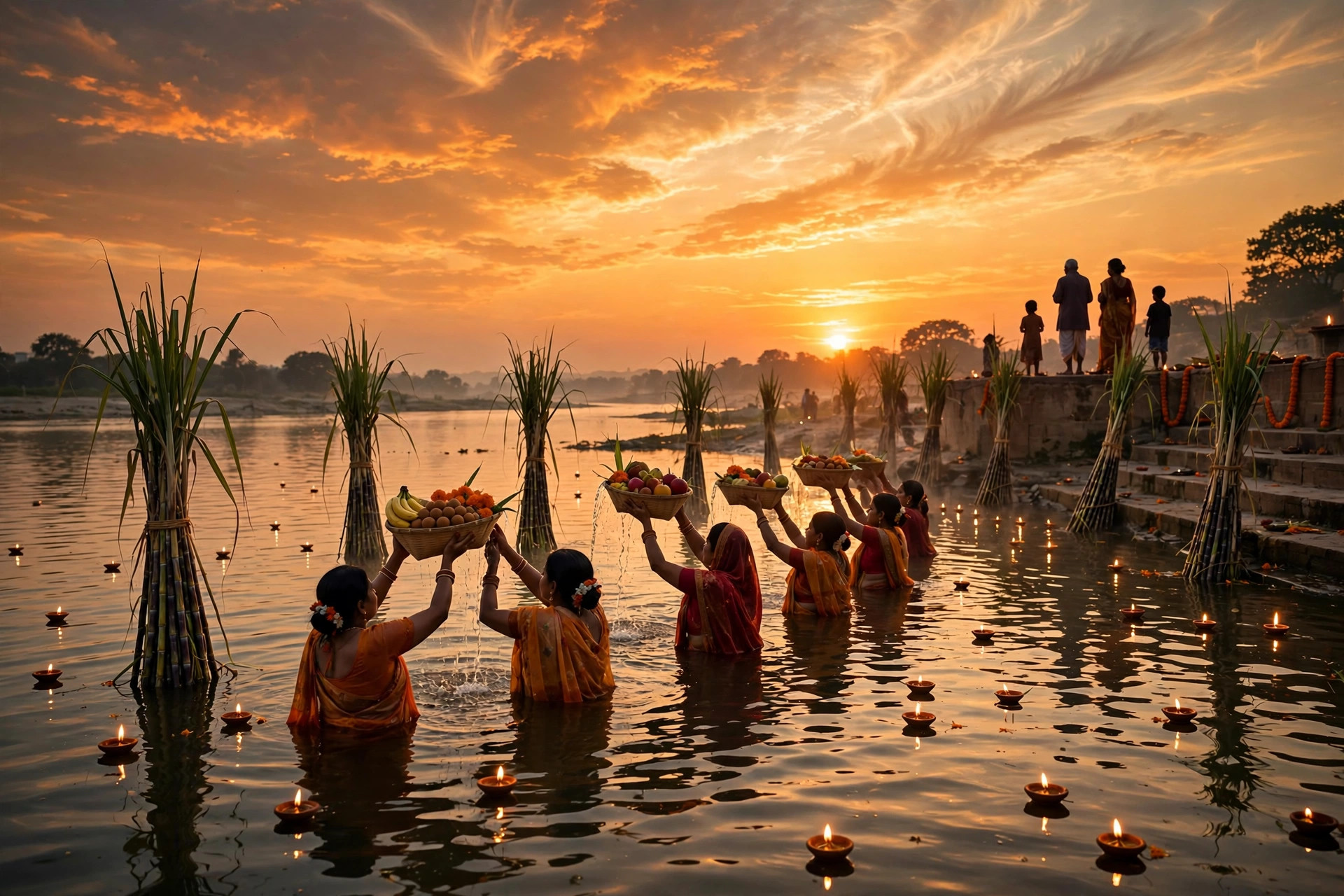
The heart of Chhath. In the afternoon, the family decorates the soop (bamboo winnow) and daura (basket) — filled with thekua, kasar (rice-flour sweets), a whole bunch of green bananas, coconut, sugarcane stalks, pomelo (daabh nimbu), raw turmeric and ginger plants, radish, diyas, sindoor and incense. Sugarcane stalks are tied upright to form the mandap-like frame of the soop.
At the ghat (riverbank or water tank), the vrati wades into the water waist-deep as the sun begins to sink. Water and milk are poured as arghya to the setting Sun while family members sing folk songs (Chhathi Maiya ke geet). The diyas are lit at the ghat's edge; the atmosphere at sunset on Sandhya Arghya evening — thousands of diyas on the water, entire families standing together — is the defining image of Chhath.
Day 4 — Usha Arghya & Parana (Monday, Nov 16): Dawn and Release
Before sunrise, families return to the ghat. As the sun rises — around 6:44 AM IST — the final arghya is offered to the rising Sun, again standing in water. Prayers are said for the family's health and prosperity. After the morning offering, the vrati breaks the fast (Parana) with the prasad — ending the 36-hour nirjala vrat. The prasad is then distributed among family, friends and neighbours; sharing it is considered essential to completing the vrat.
Chhath Puja Samagri Checklist
Gather these before Day 3. Traditions vary slightly by family (parampara), but this covers the essentials:
- Bamboo soop (winnow) and daura (basket), 2–3 pieces
- Thekua — the signature wheat-jaggery sweet (also called khajur/tikri); kasar (rice-flour jaggery balls)
- Sugarcane stalks with leaves; a whole bunch of green bananas; coconut
- Seasonal fruits: pomelo (daabh nimbu), custard apple, apple, guava, orange, water chestnut
- Raw turmeric and ginger plants (with leaves), radish (mooli)
- Lota/kalash (copper or brass) for arghya — water and milk
- Earthen diyas, ghee, cotton wicks; incense sticks; camphor
- Sindoor (the long-braid application is traditional), kumkum, akshat, flowers
- Ganga jal, honey, betel leaf and nut, new clothes for the vrati
- Wheat, rice, jaggery, ghee, fennel — for thekua/kasar preparation
Everything cooked for prasad must be prepared fresh with clean utensils, and the cook traditionally does not taste it.
Thekua: The Signature Prasad
If Chhath has a taste, it is thekua — a dense, crisp wheat-jaggery cookie, deep-fried in ghee, often imprinted with a carved wooden mould (saancha). It is made from just three core ingredients — whole wheat flour, jaggery and ghee (some families add fennel seeds and grated coconut) — and keeps for days, which is why the vrati can prepare it ahead of the festival. Kasar, kheer-puri, malpua and rice ladoos complete the prasad basket.
The Legend: Why Chhathi Maiya Is Worshipped
The Brahma Vaivarta Purana tells that King Priyavrat, son of Swayambhu Manu, was childless. On Maharishi Kashyap's advice he performed a yajna for a son; Queen Malini gave birth, but the child was stillborn. As the grieving king watched, a divine craft descended from the sky carrying Shashthi Devi — who revealed herself as Lord Brahma's manas-putri (mind-born daughter), protector of all children. She touched the child and restored it to life. The overjoyed king worshipped her — and the tradition of honouring Shashthi (Chhathi Maiya) for children's blessings began.
Other tellings connect the vrat to Draupadi (observed for the Pandavas) and to Lord Rama and Sita (said to have observed it six days after returning to Ayodhya after Diwali). The legends differ; the core is constant: the Sun as life-giver, Chhathi Maiya as protector of children, and discipline as devotion.
Practical Guidance for First-Timers
- Nirjala is genuinely demanding. Pregnant women, the elderly, diabetics and anyone with a medical condition should consult a doctor before attempting the 36-hour waterless fast; many families accept a modified observance with permission of the family tradition.
- Women lead the vrat, but men increasingly participate — Chhath has no caste or gender barrier in practice.
- Ghat logistics: reach the ghat early on both days; popular ghats fill up fast. Urban families without river access build temporary tanks — check your municipality's designated Chhath sites (Delhi, for example, sets up Yamuna and park-based ghats annually).
- Dress for water: the vrati stands in the river; carry a change of clothes and arrive before the crowd.
- No tasting the prasad while cooking it, and keep the prasad basket strictly separate from regular food until the arghya is complete.
- Prostration marches (dandvat yatra): some devotees perform the dandvat (full prostration) journey to the ghat as an additional vow — this is voluntary and intense.
Significance: Why Chhath Endures
Chhath is one of the few living rituals that can claim a direct line to Vedic sun worship — its practices are referenced in both the Rigveda and Atharvaveda. But its endurance is less about antiquity and more about what it does socially: the four days pull families home (it is Bihar and eastern UP's biggest travel week of the year), bind neighbourhoods through shared prasad, and put discipline — physical, bodily discipline — at the centre of devotion. There is no priestly intermediary, no temple required, no expensive ritual economy: a river, the sun, a bamboo basket of home-cooked sweets, and 36 hours of faith.
FAQs
When is Chhath Puja in 2026? Friday, November 13 to Monday, November 16. The main day (Sandhya Arghya) is Sunday, November 15; the fast ends after the Usha Arghya on Monday morning, November 16.
What is the time of Sandhya Arghya in 2026? The evening arghya is offered as the sun sets on Nov 15 — around 5:28 PM IST (northern India, Drik Panchang-based). Arrive at the ghat well before; the vrati stands in water as the sun descends.
What time is the Usha Arghya (morning offering)? At sunrise on Monday, Nov 16 — approximately 6:44 AM IST. The nirjala fast is broken only after this offering.
Why do some sources show different weekdays for the 2026 dates? The dates (Nov 13–16, 2026) are consistent across panchang-based sources; one widely-circulated guide printed the wrong weekdays against the right dates. November 13, 2026 is a Friday — cross-check any listing against a calendar.
What is thekua and why is it special? Thekua is the signature Chhath prasad: a wheat-flour and jaggery cookie deep-fried in ghee, cooked with ritual purity (no tasting, clean utensils). It represents the vrati's labour as an offering.
Who is Chhathi Maiya? Chhathi Maiya — Shashthi Devi — is worshipped alongside Surya as the protector of children and families. Folk tradition regards her as Surya's sister and the sixth form of Prakriti; devotees pray to her for children's wellbeing and family prosperity.
Is Chhath only for Biharis? It is native to Bihar, Jharkhand, eastern UP and Nepal, but it is open to all — and is now observed by their diaspora across India and abroad.
Can I observe Chhath in a city without a river? Yes — many urban families build temporary tanks or use designated municipal ghats. Check your city's arrangements (most North Indian metros publish Chhath ghat lists in November).
Planning your Chhath week? Verify the tithi for any date on SanatanTools' Daily Panchang, find your city's exact sunrise/sunset window with the Muhurat Finder, and explore your kundli for auspicious timing guidance with the free Kundli tool.
Related reading
- Diwali 2026: Date, Lakshmi Puja Muhurat, 5-Day Festival Guide & Puja Vidhi
- Karwa Chauth 2026: Date, Moonrise Time, Puja Muhurat & Vrat Vidhi
- Devuthani Ekadashi 2026: Date, Vrat Vidhi, Tulsi Vivah & End of Chaturmas
- Kartik Purnima 2026: Date, Dev Deepawali in Varanasi, Tripuri Purnima Vidhi & Significance
- Govardhan Puja 2026: Date, Annakut Muhurat, Puja Vidhi & Significance
- Dhanteras 2026: Date, Puja Muhurat, Kya Kharidein, Vidhi & Significance
- Bhai Dooj 2026: Date, Tilak Muhurat, Puja Vidhi & Significance
- Narak Chaturdashi 2026: Date, Abhyang Snan Muhurat, Kali Chaudas & Puja Vidhi