Devuthani Ekadashi 2026: Date, Vrat Vidhi, Tulsi Vivah & End of Chaturmas
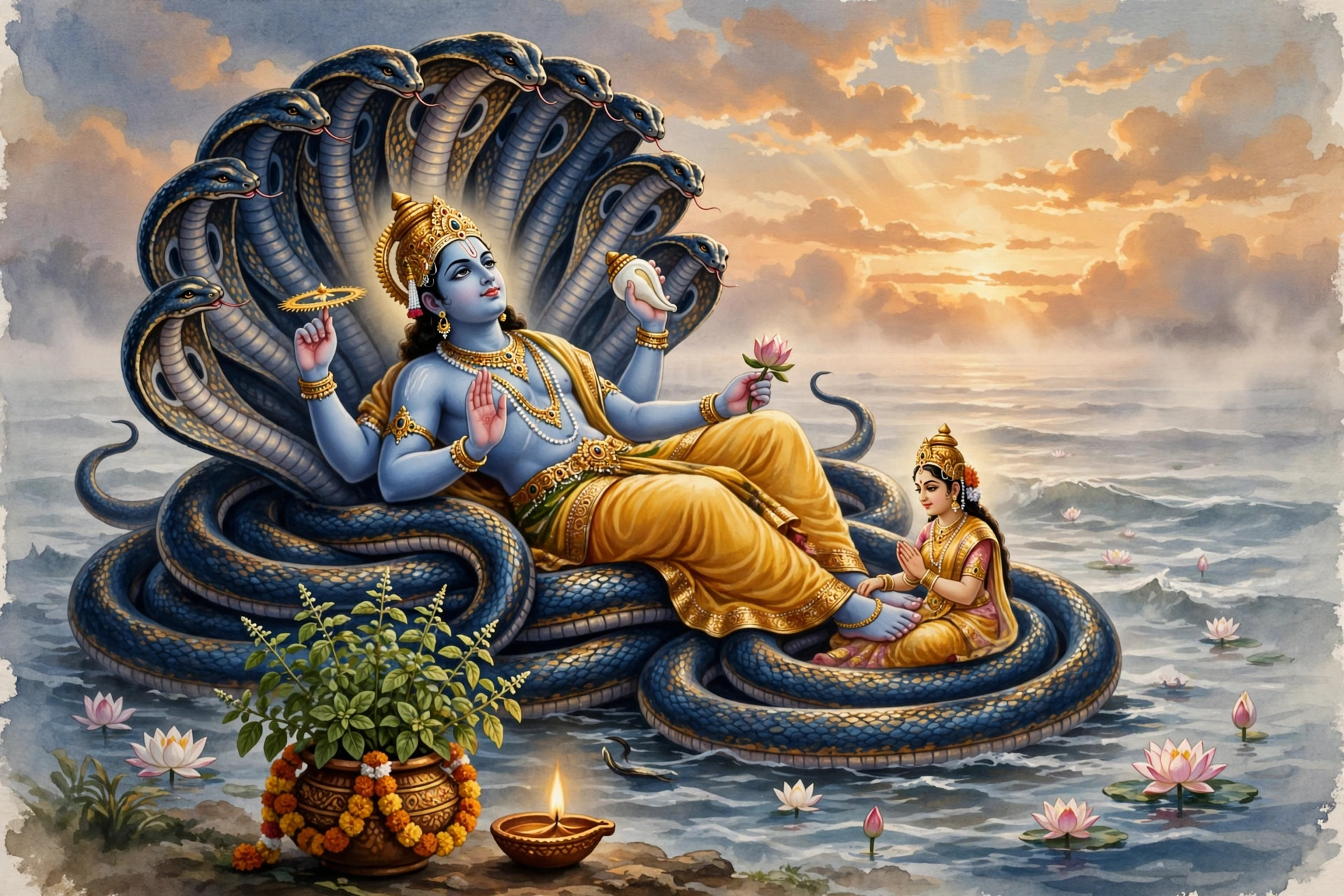
Quick Answer (Summary) Devuthani Ekadashi 2026 — also called Prabodhini or Dev Uthani Ekadashi — falls on Friday, November 20, 2026 (Kartik Shukla Ekadashi). It is the day Lord Vishnu awakens from his four-month Yoga Nidra, ending Chaturmas and reopening the calendar for weddings and all auspicious works. Devotees observe a fast, perform the evening ritual of "waking" Vishnu, and the next day — Saturday, November 21 — celebrate Tulsi Vivah, the symbolic marriage of the Tulsi plant and Lord Vishnu as Shaligram.
Devuthani Ekadashi 2026: Date & Timings
| Event | Date & Time (IST) |
|---|---|
| Devuthani Ekadashi date | Friday, November 20, 2026 |
| Ekadashi tithi begins | ~7:16 AM, Nov 20 |
| Ekadashi tithi ends | ~6:32 AM, Nov 21 |
| Fast (upavasa) | Sunrise Nov 20 to Dwadashi morning |
| Parana (breaking the fast) | November 21, after sunrise — Dwadashi |
| Tulsi Vivah | Saturday, November 21, 2026 (Dwadashi) |
Timings are Drik Panchang-based and shift slightly by city. Confirm your exact tithi on SanatanTools' Daily Panchang.
A note on the one-day difference you may see: a few listings mark the observance on Saturday, November 21 instead of Friday, November 20. This happens because the Ekadashi tithi runs into the morning of the 21st, and traditions differ on whether the fast follows the day the tithi begins or the udaya tithi (tithi present at sunrise). The overwhelming majority of panchang-based sources — and most North Indian family traditions — observe it on Friday, November 20, 2026. If your family or local temple follows a specific panchang, follow that.
What Devuthani Ekadashi Is
The name unpacks itself: Dev (god — here, Vishnu) + Uthani (awakening) + Ekadashi (the eleventh lunar day). On the eleventh day of the bright half (Shukla Paksha) of the month of Kartik, Lord Vishnu — the preserver of the universe — wakes from Yoga Nidra, the cosmic sleep he entered four months earlier on Devshayani Ekadashi (Ashadh Shukla Ekadashi, July 25, 2026).
Those four months are Chaturmas — the holy season when the gods are said to rest and all major auspicious works pause: weddings, griha pravesh (housewarmings), new ventures, sacred-thread ceremonies. Devuthani Ekadashi is the alarm clock of the Hindu calendar. From this day, the wedding season officially opens, and the calendar fills again with shubh muhurats. It is no exaggeration to say that half the weddings of North India are scheduled in the weeks that begin with this Ekadashi.
The theology is unusually human for a cosmic event. One popular telling says Goddess Lakshmi grew tired of Vishnu's erratic sleep — sometimes a day, sometimes months — and asked him to fix a schedule. Vishnu agreed: four months of rest each year, then a grand awakening. The awakening is therefore not just his — it is an invitation for the devotee to wake up too, spiritually and morally, from the "sleep" of routine and ignorance. Many katha tellings frame the day as a new beginning: sone hue devta jag gaye, ab tum bhi jag jao — the gods have woken, now you wake too.
Why Chaturmas Ends Here — and What It Means
Chaturmas coincides roughly with the monsoon and post-monsoon months — a season traditionally suited to inward spiritual practice (fasting, katha, restraint) rather than outward celebration. When Vishnu wakes, the restraint lifts: weddings resume (the first lagna dates of the season cluster from late November — check exact dates on the Muhurat Finder), and griha pravesh, mundan, yajnopavita and other samskaras can be scheduled again. Tulsi Vivah on Dwadashi is itself the ceremonial "first wedding" of the season.
Vrat Vidhi: How Devuthani Ekadashi Is Observed
The observance follows the classic three-day Ekadashi rhythm — Dashami (preparation), Ekadashi (the fast), Dwadashi (parana) — with rituals unique to this particular Ekadashi.
Day 0 — Dashami (Thursday, Nov 19): Preparation
- Take a sankalp (vow) to observe the fast with sincerity.
- Eat only one sattvic meal before sunset; avoid grains at night in many traditions, and avoid onion, garlic, meat and alcohol entirely.
- Clean the house and the puja space — the next evening, Vishnu's "footprints" will be drawn from the entrance inward.
Day 1 — Ekadashi (Friday, Nov 20): The Fast
Morning:
- Wake in Brahma Muhurta, bathe (adding a little Gangajal to the water if available), wear clean — traditionally yellow or white — clothes.
- Take the day's sankalp before your Vishnu image or Shaligram.
- Offer Tulsi leaves (never offered to Vishnu on some days, but essential today), flowers, panchamrit, fruits and naivedya.
The fast itself: The strict form is nirjala (no food, no water); the common form is phalahar — fruits, milk, water chestnut (singhara) flour preparations, sabudana. Grains, rice, wheat, lentils and beans are avoided. Water may be taken in the phalahar form. Those with medical conditions, pregnant women and the elderly should observe a modified fast — the spirit of the vrat matters more than its severity.
Evening — the "Vishnu jagao" ritual (the heart of this Ekadashi): 4. At dusk, families perform the symbolic awakening. Tiny footprints (charan) of Lord Vishnu are drawn with a paste of rice flour, turmeric and vermilion, leading from the main entrance to the puja place — as if the awakened Lord is walking into the home. 5. A sugarcane mandap is often erected — four sugarcane stalks tied together over the puja spot, decorated with marigolds. Sugarcane, singhara (water chestnut), amla and seasonal fruits are the characteristic offerings of this Ekadashi. 6. Deep daan: lamps are lit in large numbers — at the tulsi plant, the doorway, the puja place, and traditionally at temples and riverbanks. The evening aarti and the Devuthani Ekadashi katha are read or heard. 7. Many devotees keep a night vigil (jagran) with bhajans and Vishnu sahasranama recitation.
Chant: Om Namo Bhagavate Vasudevaya is the day's principal mantra; the Vishnu Sahasranama is the classic extended recitation.
Day 2 — Dwadashi (Saturday, Nov 21): Parana
The fast is broken on Dwadashi morning after sunrise, within the parana window — feed a Brahmin or the needy first in traditional practice, then eat. Parana must not be done during the Hari Vasara (the first quarter of Dwadashi) — practically, breaking the fast mid-morning on Nov 21 after sunrise satisfies the rule. Because Dwadashi tithi runs into the early hours of Nov 22, the window is comfortable; still, confirm the exact window in your local panchang.
Puja Samagri Checklist
- Image or idol of Lord Vishnu (or Shaligram stone), Goddess Lakshmi alongside
- Tulsi plant with manjari (seed pods) for offerings
- Fresh Tulsi leaves, marigold and seasonal flowers, garlands
- Panchamrit (milk, curd, ghee, honey, sugar), Gangajal
- Sugarcane stalks (for the mandap), singhara (water chestnut), amla, seasonal fruits
- Rice flour + turmeric + vermilion (for the charan footprints)
- Kumkum, akshat (rice), sandalwood paste, incense, camphor
- Ghee diyas and oil lamps (many, for deep daan)
- Sweets and fruits for naivedya and prasad
- New cloth/yellow cloth for the deity; bell and aarti thali
Tulsi Vivah: The Wedding That Opens the Wedding Season
On Dwadashi — Saturday, November 21, 2026 — comes Tulsi Vivah, the ceremonial marriage of the holy Tulsi plant (representing Goddess Vrinda, a form of Lakshmi) to Lord Vishnu in the form of the Shaligram stone (or a Krishna idol). It is treated as the season's first wedding, and attending or performing it is traditionally equated in merit with kanyadaan — giving away one's daughter in marriage.
Dwadashi tithi: begins ~6:31 AM on Nov 21, ends ~4:56 AM on Nov 22. The Vivah is typically performed in the evening (Pradosh Kaal).
The Legend of Vrinda and Jalandhar
Vrinda was the devoted wife of the demon king Jalandhar, whose invincibility came entirely from her pativrata virtue. When the gods begged Vishnu to intervene, he took Jalandhar's form to break her vow — Jalandhar fell, and the widowed Vrinda, realising the deception, cursed Vishnu to turn to stone. Vishnu accepted — hence the black Shaligram stone — and blessed her in return: she would be reborn as the Tulsi plant, worshipped by all and dearer to him than any flower, and he would marry her every year. Tulsi Vivah re-enacts that wedding.
How Tulsi Vivah Is Performed
- The Tulsi plant is decorated like a bride — red chunari or sari draped around the pot, bangles, bindi, garlands, jewellery.
- The Shaligram (or Vishnu/Krishna idol), dressed as the groom with a turban (sehra), is placed beside her under a small mandap, often of sugarcane.
- The full Hindu wedding sequence is followed in miniature: haldi, baraat (in community celebrations), kanyadaan, saptapadi (seven steps), sindoor, and mangalsutra.
- Women sing traditional vivah geet (wedding songs); prasad — especially sweets and panjiri — is distributed.
- Married women pray for their husbands' wellbeing and family harmony; unmarried women pray for a suitable life partner.
Regional note: in Nepal, where the day is called Haribodhini Ekadashi, many families perform Tulsi Vivah on Ekadashi itself (Nov 20), while most Indian traditions hold it on Dwadashi (Nov 21). Both are established practice — follow your family tradition.
The Kartik Arc: Ekadashi → Vivah → Purnima
Devuthani Ekadashi is best understood as the middle of a sacred sequence that fills late Kartik:
| Date 2026 | Observance | Significance |
|---|---|---|
| Fri, Nov 20 | Devuthani / Prabodhini Ekadashi | Vishnu awakens; Chaturmas ends; fast + evening jagaran |
| Sat, Nov 21 | Tulsi Vivah (Dwadashi) | Divine wedding; wedding season opens |
| Late Nov | Kartik Purnima / Dev Deepawali | The "Diwali of the gods" — sacred bathing, deep daan, Varanasi's great lamp festival |
In Ayodhya, Devuthani Ekadashi also draws thousands for the Panchkosi Parikrama — a 15-km circumambulation of the sacred city, walked through the night with Ram naam chanting. In Varanasi, Mathura and Ayodhya, temples hold special uthapana (awakening) ceremonies with conch-blowing and elaborate aarti.
Significance: Why This Ekadashi Matters Most of the 24
Of the 24 Ekadashis in the year, Devuthani is consistently ranked the most significant — and the reasons are structural, not sentimental:
- It ends Chaturmas. Four months of suspended auspiciousness resolve in a single dawn — every wedding invitation printed from late November onward traces back to this tithi.
- It is Vishnu's personal festival. Ekadashi is already Vishnu's favourite tithi; this one celebrates him — his waking and return to preserving the universe.
- It carries a built-in ethic. The "awakening" is read inwardly too: rise from spiritual sleep, resume discipline, begin again. The fast, the vigil, the lamps — all structured as a deliberate restart.
- It is socially load-bearing. Tulsi Vivah gives families without daughters the merit of kanyadaan; the sugarcane mandap and deep daan turn whole neighbourhoods into participants.
Frequently Asked Questions
When is Devuthani Ekadashi in 2026? Friday, November 20, 2026 (Kartik Shukla Ekadashi). A minority of listings observe it on Saturday, November 21 — check your local panchang if your family tradition differs.
What is the parana (fast-breaking) time? On Dwadashi, Saturday, November 21, after sunrise. Published windows differ slightly (one widely-used listing gives early afternoon Nov 21); the safe rule is: after sunrise, before Dwadashi ends (~4:56 AM Nov 22), and never during Hari Vasara.
Is Tulsi Vivah on the same day as Devuthani Ekadashi? In most Indian traditions, no — Tulsi Vivah is on Dwadashi (Nov 21, 2026). In Nepal (Haribodhini Ekadashi), many observe it on Ekadashi itself. Both are valid; follow your parampara.
What is special about the evening ritual? The charan footprints drawn from the doorway to the puja place symbolise the awakened Vishnu entering the home, and the sugarcane mandap with deep daan turns the house into a celebration space. It is the most distinctive ritual of this Ekadashi.
Can I keep the fast if I cannot do nirjala? Yes. The phalahar form (fruits, milk, singhara/sabudana preparations, water) is the common observance. Those with health conditions should modify the fast — consult your doctor and your family tradition.
Why do weddings start after this Ekadashi? Because Chaturmas — the four months when auspicious works are suspended while Vishnu sleeps — ends on this day. Tulsi Vivah on Dwadashi is symbolically the season's first wedding.
What mantra should I chant? Om Namo Bhagavate Vasudevaya through the day, and the Vishnu Sahasranama for extended recitation, especially during the evening jagaran.
What is offered to Vishnu on this day? Tulsi leaves (essential), panchamrit, sugarcane, singhara, amla, seasonal fruits and sweets — plus the deep daan of many lamps in the evening.
Finding your wedding date this season? Use SanatanTools' Muhurat Finder for city-exact shubh muhurats, check the Daily Panchang for tithi and Ekadashi dates through the year, or explore your own chart with the free Kundli tool.
Related reading
- Diwali 2026: Date, Lakshmi Puja Muhurat, 5-Day Festival Guide & Puja Vidhi
- Karwa Chauth 2026: Date, Moonrise Time, Puja Muhurat & Vrat Vidhi
- Chhath Puja 2026: Dates, Arghya Timings, 4-Day Vidhi & Puja Samagri
- Kartik Purnima 2026: Date, Dev Deepawali in Varanasi, Tripuri Purnima Vidhi & Significance
- Govardhan Puja 2026: Date, Annakut Muhurat, Puja Vidhi & Significance
- Dhanteras 2026: Date, Puja Muhurat, Kya Kharidein, Vidhi & Significance
- Bhai Dooj 2026: Date, Tilak Muhurat, Puja Vidhi & Significance
- Narak Chaturdashi 2026: Date, Abhyang Snan Muhurat, Kali Chaudas & Puja Vidhi